
Most homeowners never look at their attic insulation after the crew leaves. The hatch closes, the invoice gets paid, and the work is taken on trust. That is a problem, because the attic is the one part of the house where a poor job is almost invisible from below, and where the difference between a good install and a rushed one shows up on every heating bill for the next twenty years.
This guide covers two things Ontario homeowners ask about most: how the current attic insulation rebate works, and how to check the work yourself once the job is done.
Why Attic Insulation Matters in Ontario Homes
Heat rises, and in an under-insulated attic it leaves through the roof. The signs are familiar: upstairs rooms that are hot in July and cold in January, uneven snow melt on the roof, and icicles along the eaves. Many older homes across the GTA were built to insulation standards that are decades out of date, and even newer homes can underperform if the attic was not air sealed properly during construction.
Topping up or replacing attic insulation is usually a one-day job, and it is one of the few home upgrades with a rebate currently attached to it.
How the Attic Insulation Rebate Works
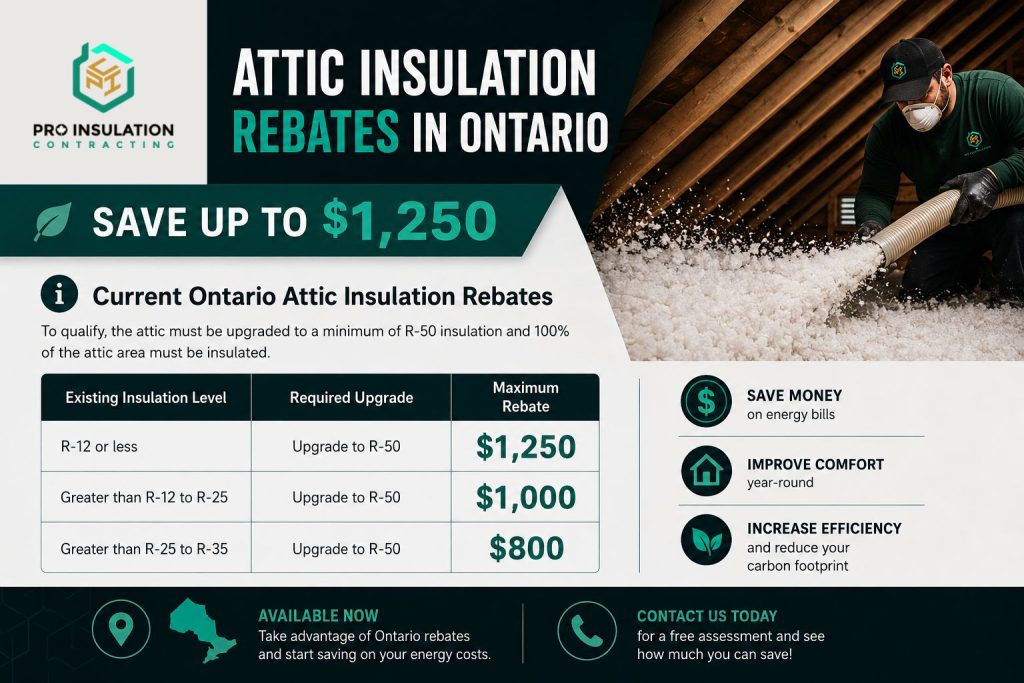
Ontario’s current rebate for attic upgrades runs through the Home Renovation Savings Program, offered by Enbridge Gas and Save on Energy. There are two ways in.
The standalone attic path. This is the simple route. No home energy assessment is required, and the rebate is up to $1,250 for a standard attic, or up to $750 for a cathedral ceiling or flat roof. The amount depends on how much insulation you start with and the level you upgrade to. The work must be done by a contractor registered with the program.
The assessment path. If you are combining the attic with other upgrades, such as air sealing, windows, or doors, a registered energy advisor assesses the home before and after the work. This route takes longer but can unlock larger rebates.
Three points to keep in mind before you sign anything:
- Confirm you are eligible first. Starting insulation level, the contractor’s registration, and the order of the steps all affect whether you get paid.
- Do not start work before you know which path you are on. On the assessment path, work done before the first assessment may not count.
- Programs change and close. This one is currently scheduled to end on November 30, 2026, and past Ontario rebate programs have closed with little notice.
If you would like help confirming eligibility and handling the paperwork, you can check whether you qualify for the attic insulation rebate before booking the job.
How to Check Attic Insulation After the Job Is Done
You do not need to be a contractor to verify the work. You need a flashlight, a tape measure, a dust mask, and ten minutes. Step only on the joists or a walkway, never on the drywall between them.
1. Measure the depth in several places
Blown-in insulation should be level, like fresh snow, not piled high near the hatch and thin at the edges. Measure at the hatch, in the middle, and as close to the eaves as you can safely reach. A careful installer leaves depth rulers stapled to the trusses so the depth is visible at a glance.
2. Ask for the attic card
The installer should leave a card or certificate, usually near the hatch, stating the product used, the R-value installed, the installed thickness, the area covered, and the number of bags used. No card is a red flag.
3. Do the bag math
Every bag of blown-in insulation has a coverage chart printed on it showing how many bags are needed per area to reach a given R-value. Compare the bag count on your attic card and invoice against that chart. This is the single most reliable check that you received the R-value you paid for, because depth alone can be faked by fluffing the material.
4. Check the eaves and ventilation
Look toward the edges of the roof. There should be baffles (rafter vents) holding the insulation back from the soffit vents so outside air can still flow in. Insulation stuffed tight into the eaves blocks ventilation and leads to moisture and ice dam problems.
5. Look at the attic hatch
The hatch is often the biggest hole in the ceiling. It should be insulated on top and weatherstripped around the edge so it closes tight.
6. Check for clearance around heat sources
Insulation should be kept back from chimneys, metal flues, and any older pot lights that are not rated for insulation contact. Ask the installer what was done around each one.
7. Confirm the exhaust fans vent outside
Bathroom and kitchen fan ducts should run to a roof or wall vent, not end inside the attic or sit buried and disconnected under new insulation. Moist air dumped into an attic causes mould and frost.
8. Get the photos
Air sealing around wiring holes, plumbing stacks, and top plates has to happen before the insulation goes down, so it cannot be inspected afterward. Ask for before, during, and after photos. Keep them with your invoice and attic card. You will want that documentation for the rebate as well.
What to Watch for Over the First Winter
The real test comes with the weather. After the first snowfall, look at your roof: snow should melt evenly and slowly, without bare patches above the living space. Icicles along the eaves should be smaller or gone. Upstairs rooms should hold temperature better, and the furnace should run less often. If none of that changes, call the installer back while the labour warranty still applies.
Frequently Asked Questions
How much is the attic insulation rebate in Ontario?
Up to $1,250 through the standalone attic path, and up to $750 for cathedral ceilings and flat roofs. Larger amounts are possible when the attic is part of an assessed, multi-upgrade project. Confirm current amounts before you book.
Do I need an energy assessment to get the rebate?
Not for the standalone attic path. An assessment is required if you are bundling the attic with other upgrades.
How long does attic insulation take to install?
Most residential attics are completed in a single day. Removal of old or contaminated insulation adds time.
Can I check the attic myself?
Yes, if you can reach the hatch safely. Stay on the framing, wear a mask, and keep it short. If you are not comfortable going up, ask the installer for photos with a tape measure in the frame.
The Bottom Line
Attic insulation is one of the best-value upgrades for an Ontario home, and the rebate makes it cheaper. But the rebate only pays for the job, it does not guarantee the quality. Measure the depth, read the attic card, do the bag math, and keep the photos. A contractor who does good work will be glad you looked.